
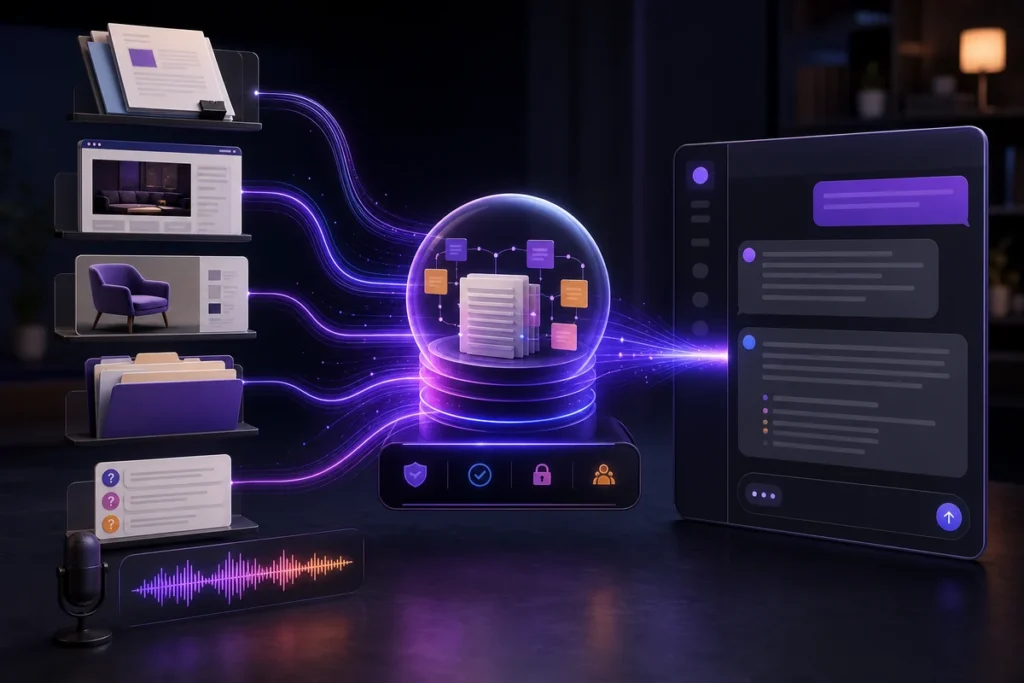
A dependable AI assistant is not created by uploading the largest possible collection of files. It is created by giving the system clear, current, relevant knowledge and managing that knowledge over time.
Training a Twiin is partly an AI task, but it is also a knowledge-management task.
Begin with a defined purpose
Write one sentence describing who the assistant helps and what it helps them do.
Examples:
- Help hotel guests understand amenities, policies, and local recommendations
- Help shoppers compare product features and compatibility
- Help coaching clients revisit one methodology between sessions
- Help RV renters understand normal features and rental procedures
Purpose determines which knowledge belongs.
Identify authoritative sources
Decide which documents should win when information differs.
Possible sources include:
- Current website pages
- Approved policy documents
- Product manuals
- Specification and compatibility tables
- Menus
- Training guides
- Service descriptions
- Support articles
- Images and diagrams
- Owner or expert dictation
Do not treat every old file as equally trustworthy.
Remove outdated and duplicate information
Businesses often have several versions of the same guide. One employee uses an old PDF while the website shows a newer policy.
Resolve this before training.
If conflicting information enters the knowledge base, the assistant may provide inconsistent answers. AI cannot reliably fix an authority problem the business has not settled.
Make implicit knowledge explicit
Important knowledge often exists only in someone’s memory.
Interview the people who answer questions every day. Ask:
- What do customers misunderstand?
- What do you explain repeatedly?
- Which exceptions matter?
- What should never be promised?
- When must a person take over?
Record and approve these explanations before adding them.
Organize by audience and context
Separate information when audiences or locations differ.
One rental property should not inherit appliance instructions from another. One product model should not inherit compatibility rules from a similar model. Internal procedures should not appear in a public customer assistant.
Clear structure reduces accidental mixing.
Add communication guidance
Knowledge determines what the Twiin knows. Communication guidance shapes how it responds.
Define:
- Preferred tone
- Typical answer length
- Terms the business uses
- How to handle uncertainty
- When to ask a follow-up question
- When to provide a link
- When to escalate
Do not instruct the assistant to sound confident when the source is incomplete. Honest uncertainty builds more trust than a polished guess.
Define prohibited and sensitive areas
Examples include:
- Private customer information
- Door and access codes
- Payment details
- Internal credentials
- Unsupported safety advice
- Unapproved refunds or exceptions
- Medical, legal, or financial claims outside the business’s scope
Use the minimum information necessary for the purpose.
Test with real questions
Create a test set from customer emails, support conversations, staff experience, and common search queries.
Include:
- Normal questions
- Misspellings
- Incomplete questions
- Two-part questions
- Requests for exceptions
- Questions outside scope
- Safety-sensitive questions
Compare every important answer with the authoritative source.
Fix knowledge problems at the source
When an answer fails, do not only rewrite the prompt.
Ask whether the source is missing, unclear, contradictory, or poorly organized. Improving the source often improves future answers more reliably.
Establish an update routine
Assign an owner and review the knowledge whenever products, prices, policies, services, staff responsibilities, or safety guidance change.
Review unanswered and frequently asked questions on a regular schedule.
Training is an ongoing business process
A Twiin becomes more valuable as its knowledge becomes clearer and more complete.
The goal is not to make an assistant that answers everything. The goal is to make one that answers the right questions accurately, communicates within its boundaries, and knows when a person is needed.

