
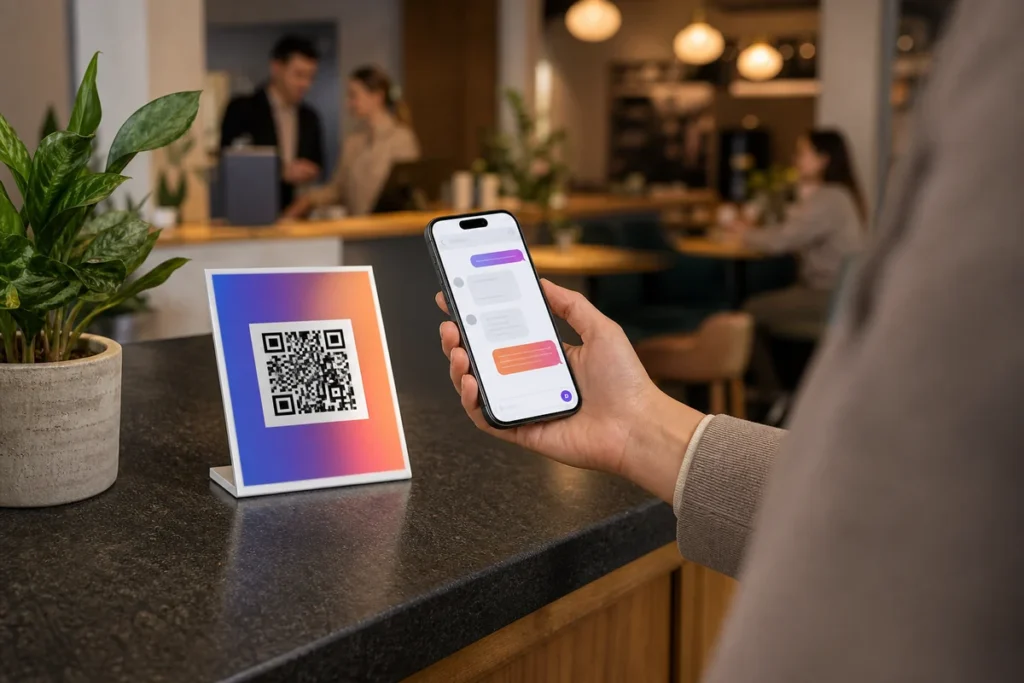
Customers rarely experience a business as a neat collection of webpages and documents. They experience it in moments.
They stand beside a product and wonder whether it is compatible. They arrive at a rental and cannot operate the thermostat. They sit in a restaurant and need ingredient information. They enter a hotel room and want to know when breakfast begins.
A QR code AI assistant connects those physical moments to useful answers.
QR codes remove the search step
Traditional self-service often makes the customer do too much work. They search the website, locate a PDF, open a long guide, or wait in a phone queue.
A well-placed QR code can open the relevant Twiin immediately. The customer asks a question in their own words instead of guessing which menu or document contains the answer.
The reduction in effort is the first customer-experience benefit.
Conversation is easier than navigation
Documents are organized by the person who wrote them. Questions are organized by the situation the customer is in.
A manual may place accessory compatibility on page forty-two. A customer simply asks, “Will this battery work with the tool I already own?”
A conversational assistant bridges that difference. It does not eliminate the need for authoritative documentation, but it makes approved information easier to explore.
Physical context makes answers more relevant
A QR code can lead to a Twiin designed for a specific product, property, vehicle, room, or service.
That context matters. A code inside an RV can prioritize the controls and policies for that rental. A code beside a power tool can prioritize the specifications and compatible accessories for that model.
The closer the destination matches the physical placement, the less information the customer must provide before receiving a useful answer.
Customers can get help outside normal hours
Many routine questions happen when staff are unavailable or busy.
A guest may arrive late. A renter may need guidance early in the morning. A product owner may begin setup on the weekend.
A Twiin can make approved information available around the clock. It should also explain when the customer must contact a person, emergency service, technician, or other official channel.
Availability should never become false confidence. Good escalation is part of good service.
Staff can focus on higher-value interactions
QR code assistants are not intended to eliminate human hospitality or expert advice. They can reduce the repetitive informational questions surrounding that work.
When customers can quickly retrieve Wi-Fi instructions, opening hours, basic product specifications, or standard policies, staff have more time for exceptions, judgment, empathy, and service recovery.
QR interactions reveal information gaps
The questions people ask form a useful feedback stream.
If hotel guests repeatedly ask where to park, the pre-arrival information may be unclear. If shoppers repeatedly ask about compatibility, the shelf display may need improvement. If renters struggle with one control, the handoff process may need a better demonstration.
The Twiin can help answer the immediate question while the business uses the pattern to improve the underlying experience.
The QR code needs a clear promise
A bare QR code does not explain why it deserves attention.
Add a short invitation such as:
- Scan to ask about this product
- Scan for guest help
- Scan for menu and ingredient questions
- Scan for RV features and rental policies
Keep the code large, high-contrast, and surrounded by open space. Test it in the real environment, not only on a computer screen.
Privacy and safety still matter
Do not place private account data, door codes, payment details, or sensitive customer information in a broadly accessible assistant.
Safety-critical questions should preserve official warnings and direct customers to trained help when conditions are unknown.
Better access creates a better experience
The value of a QR code AI assistant is not the code itself. The value is the connection between a real customer moment and a trusted answer.
When the placement is thoughtful, the knowledge is accurate, and the boundaries are clear, a simple scan can make a business feel more responsive without making the customer wait.

