
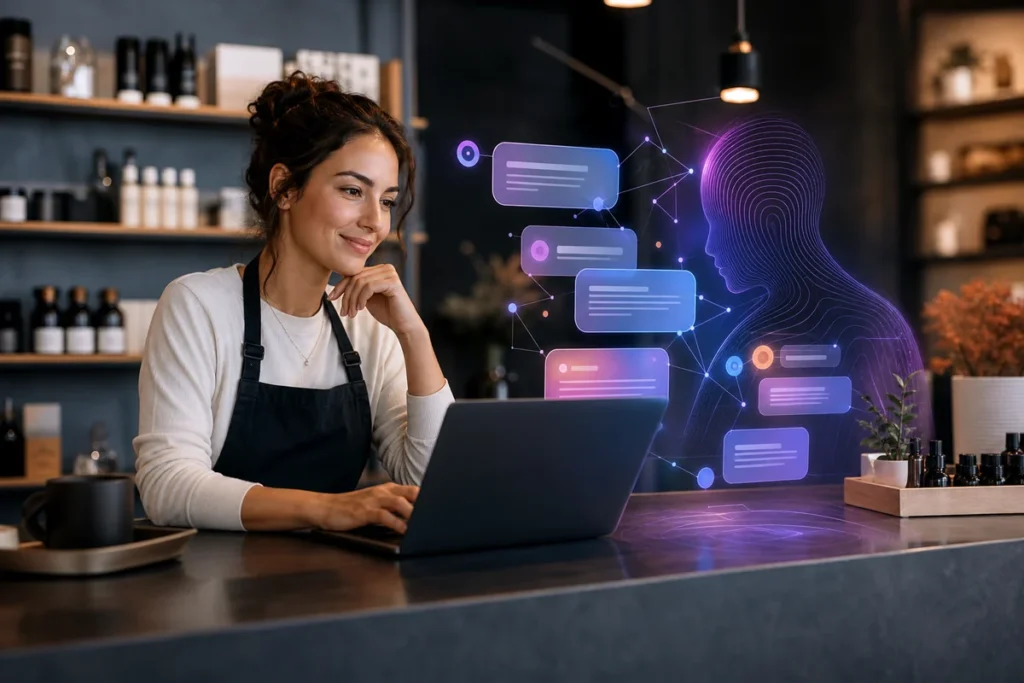
An AI digital twin is an interactive representation of a person or business. It is trained on the knowledge, documents, policies, explanations, and communication style that its owner chooses to provide. Instead of making customers search through pages, PDFs, or old messages, the digital twin lets them ask questions in normal language.
For a small business, this can be surprisingly practical. The goal is not to create a science-fiction copy of a person. The goal is to make useful knowledge easier to reach.
A digital twin turns business knowledge into a conversation
Every business has information that customers repeatedly need. A restaurant has menu details and dietary information. A hotel has amenity hours, policies, and local recommendations. A rental host has check-in instructions and appliance guidance. A coach has frameworks, exercises, and frequently repeated explanations.
Much of this knowledge already exists, but it is scattered across documents, websites, inboxes, guides, and the owner’s memory. A Twiin brings approved sources together and makes them conversational.
A customer can ask, “Is there parking nearby?” or “Which attachment works with this tool?” The Twiin uses the knowledge it has been given to respond. When a question is outside its scope, it should say so and direct the person to the right human.
How small businesses can use a Twiin
The most useful applications begin with repeated questions. Look for questions that are important but do not require a person’s judgment every time.
Examples include:
- Restaurant ingredients, preparation, hours, reservations, and accessibility
- Hotel Wi-Fi, breakfast, parking, checkout, and local recommendations
- Vacation-rental check-in, house rules, appliances, and neighborhood information
- Product features, specifications, compatibility, setup, and care
- Coaching frameworks, exercises, and between-session reminders
- Service policies, onboarding steps, and common customer questions
A Twiin can be shared through a direct link, embedded on a website, or opened from a QR code. The QR option is especially useful when the question happens in a physical place. A guest can scan a code in a hotel room, a renter can scan a code inside an RV, or a shopper can scan a code beside a product.
What makes a Twiin different from a generic chatbot
A generic chatbot begins with broad general knowledge. A useful business Twiin begins with your approved information and a defined purpose.
That difference matters. Your Twiin should know which sources to use, what tone fits your business, what it is allowed to answer, and when it must escalate. It should not invent policies, guess about safety, or make promises your business cannot keep.
The best results come from clear sources and clear boundaries.
Start with one focused use case
Small businesses do not need to automate everything at once. Choose one audience and one set of questions.
For example, a vacation-rental owner might begin with arrival, Wi-Fi, appliances, house rules, and checkout. A hardware retailer might begin with one product category and its most common compatibility questions. A coach might begin with one signature framework.
Test the Twiin with real questions before publishing it. Ask employees, customers, or trusted partners to try confusing wording and edge cases. Correct weak answers and add missing information.
The real benefit is multiplied availability
An AI digital twin does not replace the relationships that make a small business special. It protects those relationships by handling the repeatable information around them.
Customers get an answer when they need it. Staff spend less time repeating the same details. Owners make more of their knowledge available without adding more hours to the day.
That is the practical promise of a Twiin: your knowledge, made easier to access, while you remain in control of what it knows and how it helps.
